How to start a home bakery: from recipe to first order
Before taking paid orders, check what you're allowed to sell, test your recipes, and price your work properly. These eight steps explain how to start a baking business from home in the US, from choosing a small menu to reviewing your first sale.
Disclosure: We make BakeValue, the recipe-costing and product-pricing app shown below. Manage legal requirements, food safety, customer orders, payments, and taxes separately.
1. Which cottage food laws apply to your home bakery?
Find your state cottage-food program and local office before selling. The FDA explains that a private residence isn't an FDA-registered facility, but state and local requirements still apply.
Ask which foods, sales channels, pickup, delivery, and shipping methods are allowed. Check permits, training, zoning, inspections, labels, and tax registration. Keep the written guidance, contact name, and date.
For example, California distinguishes direct sales from sales through stores or restaurants. Illinois has its own guidance. Use the rules for your location.
Follow required label wording and the FDA's allergen guidance. List ingredients honestly and plan how to prevent allergen cross-contact. A disclaimer doesn't make a shared kitchen allergen-free.
2. How do you choose a small starting menu?
Decide who you're baking for and why they would order. The SBA's planning guidance recommends researching customers and competing businesses before launch. Compare local prices, portions, presentation, pickup times, and notice periods without copying another seller.
Start with a few products that share ingredients and equipment. For each, state the quantity, flavor, and customization limits. Leave untested substitutions and designs for later.
In BakeValue, a product is the finished item you sell, such as a box of cookies. The Products tab keeps those items together.

Create your first product in BakeValue
Watch how to create a product, attach its recipe, and set its price. This video shows the whole process; finish your recipe tests before entering final costs.
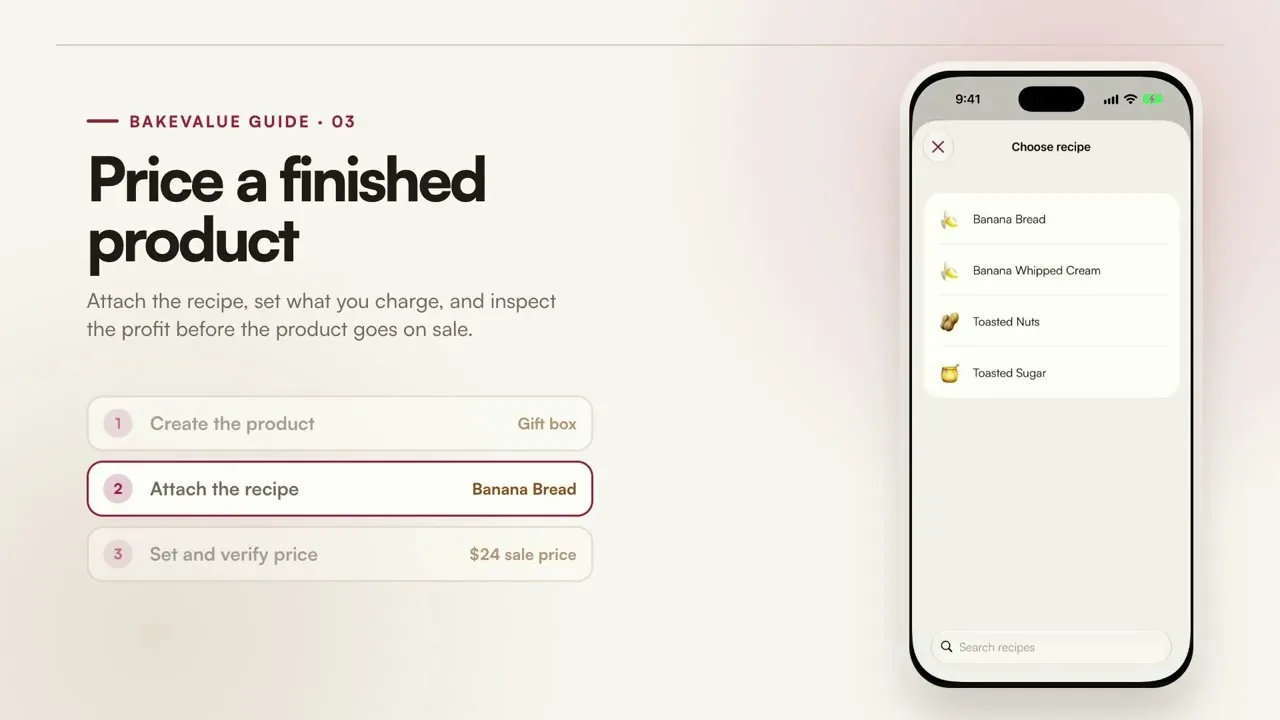
YouTube loads only after you press play. Watch on YouTube.
3. How do you test a recipe before taking orders?
Use the kitchen, equipment, and packaging you'll use for orders. Weigh ingredients and portions, count the items you can actually sell, and time everything from preparation through cooling, packing, and cleanup. Repeat on another day and change one thing at a time.
Keep a dated recipe record with amounts, finished count, hands-on and total time, storage life, and packaging. Here's a fictional example, not a production benchmark:
Chocolate-chip cookies, version 1. Portions: 40 grams. Baked: 25; rejected: 1; sellable: 24. Active work: 40 minutes preparing, 25 packing, 25 cleaning; 90 total. Start to finish: 3 hours 20 minutes, including baking and cooling. Packaging: two 12-cookie boxes. Next test: repeat the portion weight and check the yield.
BakeValue connects ingredient purchase costs to recipes and sub-recipes. Save a shared filling or frosting as a sub-recipe to reuse its cost. A spreadsheet works too.

4. What startup costs should you budget for?
Write down what you'll need to pay before your first sale: permits, training, inspections, registration, insurance, storage, equipment, photography, labels, and initial supplies. Use local fees and written quotes rather than a national startup estimate.
Buy only what your first menu needs. Account consistently for equipment you already own or share, and keep setup purchases separate from the per-batch costs in step 5.
Allow for ingredients and packaging you'll buy before customers pay, plus ongoing bills, replacements, and unexpected costs. Ask a qualified tax adviser about registration, collection, deductions, and estimated payments.
Deposits can help with cash flow, but agree the payment and refund terms in step 6 before accepting one.
5. How do you calculate costs and price baked goods?
Divide the full batch cost, including your time, by the number of items you can sell. These fictional figures illustrate the method; they aren't average costs or recommended prices, wages, or earnings.
| Cost category | Batch cost |
|---|---|
| Ingredients | $12.00 |
| Packaging | $6.00 |
| Labor (1.5 hours × $20) | $30.00 |
| Kitchen and overhead | $6.00 |
| Total batch cost | $54.00 |
| Cost per cookie ($54 ÷ 24) | $2.25 |
The $12 covers ingredients for all 25 cookies, including the rejected one. The batch costs $54. Divide by 24 sellable cookies and each costs $2.25. Kitchen and overhead cover shared running costs; don't add utilities twice if they're already included.
A 25% markup adds a quarter of cost: $2.25 × 1.25 = $2.8125 before rounding. A 25% margin means a quarter of the selling price remains after these costs: $2.25 ÷ (1 - 0.25) = $3, leaving $0.75 per cookie.
That isn't take-home income. Add payment and market fees, delivery, and a share of ongoing expenses such as insurance, software, cleaning, and replacements. Include any additional expected waste before quoting, without counting the rejected cookie twice. Collect applicable sales tax separately under local rules; it isn't profit.
If customers won't pay the full price, reconsider the portion, packaging, decoration, or batch size. Hiding costs won't make an item profitable; you may decide not to sell it.
Once your recipe is tested, attach it to its product in BakeValue and enter the remaining costs. Ingredient and recipe costs carry through; review the margin before choosing what to charge. Return to the creation and pricing video in step 2, or follow the written product-pricing tutorial.
BakeValue works on iPhone and iPad. Free supports up to 3 products, 4 recipes including sub-recipes, 25 custom ingredients, and 2 active lots per ingredient. Pro is an optional one-time purchase. Both work offline with optional private iCloud sync, no Kashi Works account, and no ads or tracking.
Download BakeValue for iPhone and iPadRead why we chose a one-time model in the guide to BakeValue's one-time pricing.
6. What should customers know before they order?
Explain how to order, when it's confirmed, how and when to pay, pickup and storage instructions, and what happens after a change, cancellation, late arrival, or missed pickup. Set change deadlines and check local law before making payments nonrefundable.
Use a reputable payment service and collect only the personal information the order needs. Check that your pickup or delivery method is allowed locally. Record payment status and ask the customer to approve a written confirmation, using your checked terms:
Order: [product and quantity]. Options: [agreed changes]. Total: [price, tax, and fees]. Payment: [method and deadline]; confirmed when [condition]. Pickup: [date, time, location]. Changes or cancellations: [terms]. Ingredients, allergens, and storage: [details]. Please reply to confirm.
7. How can you find your first home-bakery customers?
Choose one permitted sales channel, pickup date, and fixed menu. Share clear photos and ordering details with a suitable neighborhood group, school community, market, or referral network. Follow local and platform advertising rules; don't promise allergy safety if cross-contact is possible. A simple announcement could read:
Orders open for [product and portion] at [price plus applicable tax]. Order by [deadline] for pickup at [place and time]. Ingredients and allergens: [details]. To order: [method]. Available: [quantity].
Accept fewer orders than you've tested you can finish, allowing for shopping, cooling, packing, messages, pickup, and cleanup as well as baking. Leave room for mistakes and delays. A paid order at your usual terms teaches more than a compliment, so don't pressure friends to buy.
8. What should you check after your first sale?
Compare estimated and actual ingredients, sellable items, waste, packaging, fees, work time, total time, and pickup effort. Recalculate cost per item before deciding whether the price covered your work.
Fix the problem you actually found: uneven portions, unclear ordering instructions, or an awkward pickup time. Set the next order limit around the slowest step and change only one or two things so you can tell what helped.
Update costs when ingredient prices or pack sizes change. BakeValue recalculates connected recipes and products after a price update; in a spreadsheet, check the affected formulas. Keep receipt dates to explain later price changes.
Home-bakery launch checklist
Before taking payment, check each item against a document, test, or written policy. Local requirements still apply.
- Confirm legal requirements, labels, allergen precautions, insurance, and tax setup.
- Test the menu, portions, sellable yield, and timing.
- Budget setup and ongoing expenses; price each item without double-counting costs.
- Write order, payment, cancellation, change, and pickup terms.
- Limit the first sale and schedule a review of costs and customer feedback.
Frequently asked questions
Do I need an LLC to start a home bakery?
Not necessarily. An LLC is a business-structure choice. Check local permit, registration, zoning, insurance, and tax requirements with the relevant agencies and a qualified adviser.
Can I sell any baked food from home?
Usually not. State and local rules determine which foods you can sell, how to store them, and where or how customers can buy them.
Can BakeValue take orders or handle compliance?
No. BakeValue costs recipes and prices products on iPhone and iPad. Manage orders, payments, permits, taxes, accounting, labels, and food safety separately.
Sources
Official guidance checked on 2026-11-02. Confirm current requirements locally.
We're BakeValue's developers. We used these sources and calculated the fictional examples from the amounts shown; they aren't customer results or our bakery experience. If you spot an error or changed guidance, send us the source so we can review a correction.