Comparison guide
BakeValue vs CakeCost: Which is better for pricing products in a home bakery?
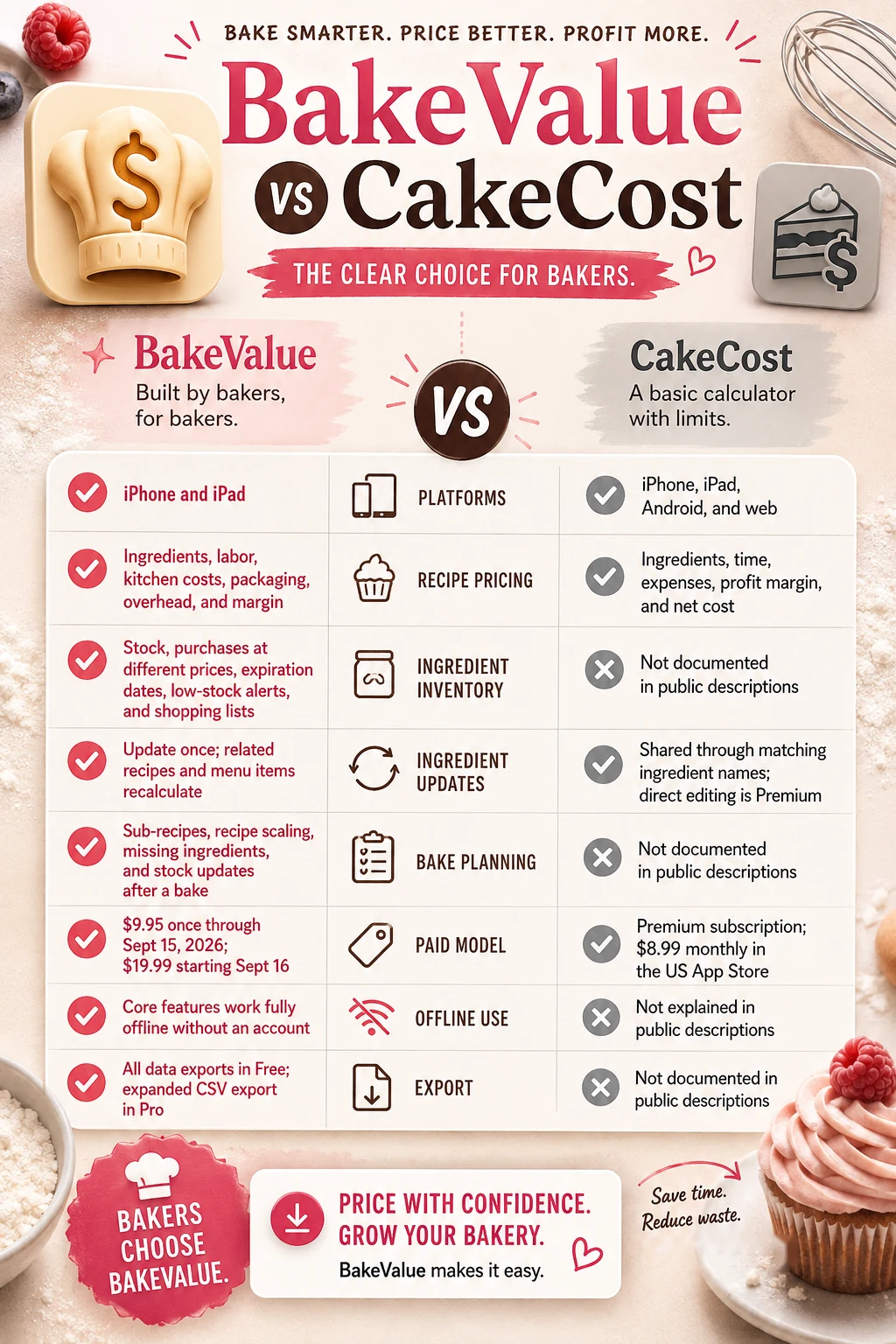
BakeValue is a better fit for iPhone and iPad bakers who want recipe costing, ingredient inventory, and help planning orders in one app. CakeCost is a practical choice if you need Android or web access.
Key takeaways
- BakeValue combines recipe costing with ingredient stock, expiration dates, shopping lists, and batch planning.
- BakeValue Pro is $9.95 once through September 15, 2026.
- CakeCost has the advantage when Android or web access is required.
From ingredient cost to selling price
Both apps calculate at least four parts of a price, including ingredients, time or labor, expenses, and profit margin. BakeValue also carries those costs into the rest of the order. Enter an ingredient purchase once, use it in recipes, then add packaging and overhead to find a selling price per item.
When an ingredient price changes, you update it in one place. BakeValue recalculates every recipe and menu item that uses it. Your selling prices stay tied to the ingredient costs and stock you already track.
BakeValue uses the same ingredient costs across your inventory, recipes, and menu prices. That reduces the chance of an old spreadsheet tab or duplicated recipe keeping the wrong price.
Keep ingredient costs in one place
BakeValue Free supports 25 custom ingredients, while built-in ingredients do not count toward that limit. Each ingredient can have two active purchase records in Free. Pro removes those limits. The same cost can be used across every related recipe and menu item.
CakeCost also reuses ingredient prices. A CakeCost developer response dated June 10, 2023 says ingredient names must match between recipes. "Pure vanilla" and "vanilla," for example, can become separate entries. The same response says direct editing from the Ingredients page requires Premium; Free users edit prices inside recipes.
This becomes useful as your recipe list grows. Each ingredient has one record for its pack price, pack size, stock, and expiration date. Your recipes use that record instead of relying on the same ingredient being typed the same way every time.
Plan what to bake and what to buy
BakeValue covers seven parts of day-to-day bakery work: ingredient costing, stock, expiration dates, shopping lists, reusable sub-recipes, menu pricing, and batch planning. CakeCost’s public pages focus on costing and profit margin. They do not describe a similar ingredient inventory and bake-planning setup.
Consider a custom cake with ganache, filling, a cake board, and a box. BakeValue can reuse the ganache and filling as sub-recipes, include the packaging in the selling price, and scale the recipe for the full order. Before you start, the pantry shows low or expiring ingredients and adds missing items to a shopping list.
This can replace more than a costing spreadsheet. Before you quote an order, you can check its real cost and see whether you have enough ingredients. Missing items can go straight onto your shopping list.
Pay once instead of every month
As of June 9, 2026, BakeValue Pro costs $9.95 once through September 15, then $19.99 once. CakeCost’s US App Store listing shows Premium at $8.99 monthly. Twelve monthly payments total $107.88 before tax.
BakeValue Free includes three products, four recipes, 25 custom ingredients, two active purchase records per ingredient, iCloud sync, and a combined all-data CSV. Pro removes those free-tier limits and exports separate CSV files for each category.
A monthly subscription becomes another fixed overhead cost for your bakery. BakeValue does its calculations on your device, so you can pay once for higher limits without adding a software charge to every future month. See how its local-first architecture avoids subscription pricing.
Privacy and platform support create the clearest trade-off
CakeCost works on iPhone and iPad, Android, and the web. BakeValue is available for iPhone and iPad. Choose CakeCost if you use Android or need to work in a browser.
BakeValue keeps normal use on your device. It requires no Kashi Works account, works offline, and uses no ads, analytics, tracking, or developer-hosted data server. Optional iCloud sync is available in both Free and Pro.
CakeCost’s Apple privacy label says usage data and diagnostics may be collected for analytics but are not linked to identity. Google Play says no data is shared with third parties, data is encrypted in transit, and deletion can be requested. Its public listings do not explain offline behavior, so we have not scored that feature.
Which app fits your bakery?
Choose BakeValue if you work on iPhone or iPad, want ingredient stock and bake planning beside your costing, and prefer a one-time Pro purchase. Choose CakeCost if you need Android or browser access.
Choose BakeValue if you want:
- Ingredient stock, recipes, menu items, and batches in one app
- Expiration dates, low-stock alerts, and shopping lists
- Reusable fillings, frostings, and other sub-recipes
- Offline use without an account or analytics
- A one-time Pro unlock instead of a subscription
Choose CakeCost if you need:
- An Android app
- A browser-based option
The verdict
For iPhone and iPad bakers who also need ingredient inventory and batch planning, BakeValue covers more of the day-to-day work. It costs the recipe, tracks the ingredients behind it, and calculates the selling price for each menu item. Choose CakeCost if Android or browser access matters more.
Learn more about BakeValueFrequently asked questions
Is BakeValue better than CakeCost?
BakeValue is the stronger choice for iPhone and iPad bakers who want recipe costing, ingredient inventory, shopping lists, packaging costs, reusable sub-recipes, and help planning upcoming bakes. CakeCost may fit better when Android or web access matters more than those extra bakery tools.
Does BakeValue require a subscription?
No. BakeValue has a permanent free tier and an optional one-time Pro purchase. CakeCost is also free to download, but its US App Store listing shows Premium Plan - Monthly at $8.99.
Does CakeCost track ingredient inventory?
We could not determine that from CakeCost’s official public materials. CakeCost documents recipe costing, ingredient prices, time, expenses, profit margin, and net cost, but its public website and store descriptions do not document stock quantities, expiration dates, shortages, or shopping lists.
Which app works on Android?
CakeCost is available on Android through Google Play and also has a web app. BakeValue is built for iPhone and iPad. BakeValue works offline and can sync privately through iCloud, but Android users should choose CakeCost between these two apps.
Can BakeValue work offline?
Yes. After installation, BakeValue’s core ingredient, recipe, product, inventory, and pricing features work offline without a Kashi Works account. Internet access is needed to purchase Pro, use optional iCloud sync, download the app, or install updates.
Methodology and sources
We compared currently published product information, not private roadmaps. BakeValue details come from the product and its public page. CakeCost details come from its official listings and website. Prices and store disclosures can change after publication. To report an error, contact Kashi Works.
- Kashi Works, BakeValue product page, retrieved June 9, 2026.
- Apple App Store, CakeCost, retrieved June 9, 2026.
- Google Play, CakeCost, retrieved June 9, 2026.
- CakeCost official website, retrieved June 9, 2026.